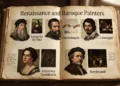




You may recognize the Mona Lisa or the swirling sky in The Starry Night without remembering who painted them. Connecting a name to one painting is a useful way to begin learning about art.
Famous painters include Leonardo da Vinci, Michelangelo, Rembrandt, Claude Monet, Vincent van Gogh, Pablo Picasso, and Frida Kahlo. Leonardo painted the Mona Lisa, Van Gogh created The Starry Night, and Picasso made Guernica.
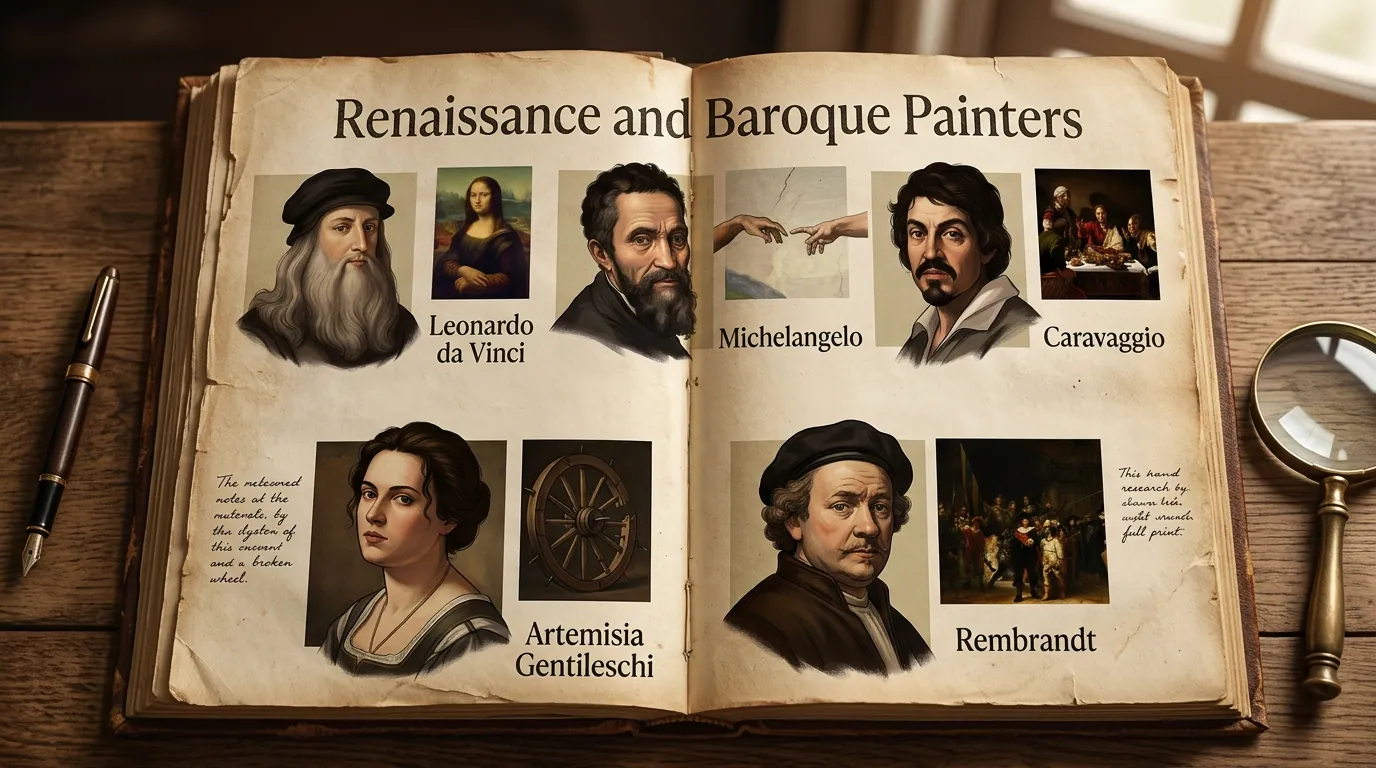
The 20 painters below provide a starting selection across several traditions and periods. Each example gives you something specific to notice, from soft shading to words inside a picture.
Direct answer:
Famous painters are artists known for influential or recognizable paintings. Examples include
Famous Painters and Their Paintings at a Glance
Use this table to choose a painting. These are representative works, rather than a ranking of each artist’s greatest achievements.
| Painter | Representative painting | One thing to notice |
| Leonardo da Vinci | Mona Lisa | Soft edges around the face |
| Michelangelo | The Creation of Adam | The space between the hands |
| Caravaggio | The Supper at Emmaus | Light and startled gestures |
| Artemisia Gentileschi | Self Portrait as Saint Catherine of Alexandria | The broken wheel |
| Rembrandt | The Night Watch | A group shown in action |
| Johannes Vermeer | Girl with a Pearl Earring | Small touches of light |
| Raja Ravi Varma | Portrait of a Lady | The handling of human form |
| Claude Monet | Water Lilies | Reflections across the water |
| Vincent van Gogh | The Starry Night | Curving marks in the sky |
| Gustav Klimt | The Kiss | Gold and patterned clothing |
| Georgia O’Keeffe | Jimson Weed/White Flower No. 1 | A flower enlarged to fill the picture |
| Fernando Amorsolo | Dalagang Bukid | Clothing and the figure’s expression |
| Amrita Sher-Gil | Group of Three Girls | Poses and areas of color |
| Frida Kahlo | Fulang-Chang and I | A ribbon linking two figures |
| Jean-Michel Basquiat | Hollywood Africans | Words beside faces |
| Pablo Picasso | Guernica | Broken forms and distressed figures |
| Salvador Dalí | The Persistence of Memory | Solid objects made soft |
| Jackson Pollock | One: Number 31, 1950 | Overlapping trails of paint |
| Alma Thomas | Light Blue Nursery | Rows of colored marks |
| Yayoi Kusama | No. F | Repeated loops forming a net |
Fame can come from influence, public recognition, exhibitions, or the reach of a particular image. Those measures do not always produce the same list. This selection includes women and artists from several regions, but it cannot represent every painting tradition.
Renaissance Painters: Leonardo and Michelangelo
The Renaissance was a period of renewed interest in classical learning and the arts in Europe. These two Italian artists offer useful starting examples of how painters studied faces, bodies, and human expression.
1. Leonardo da Vinci — Mona Lisa
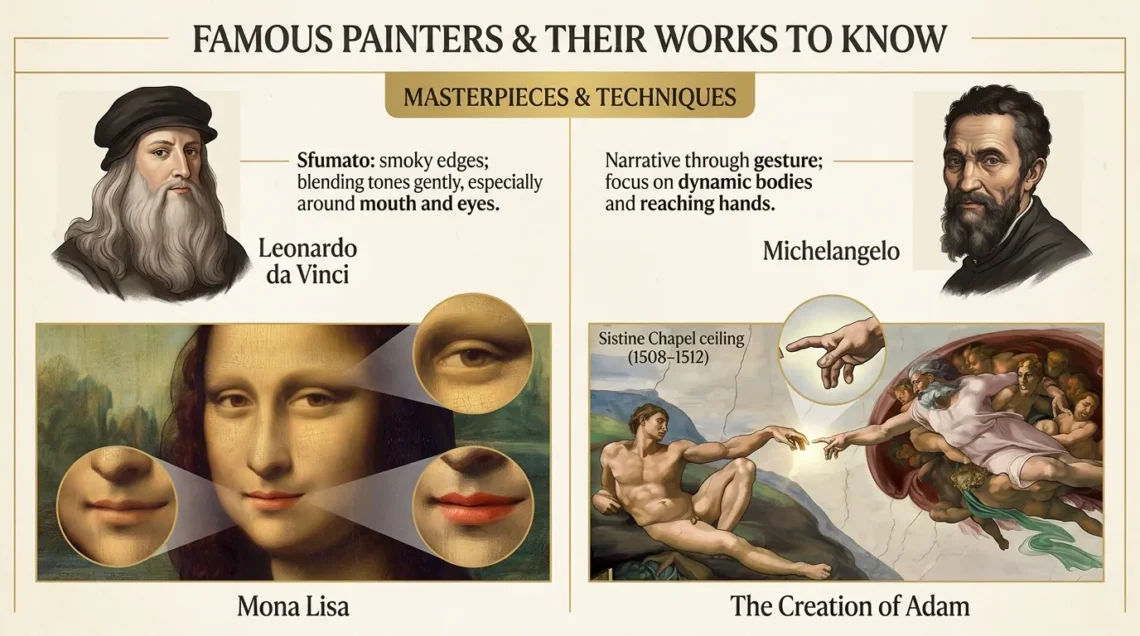
Leonardo’s Mona Lisa rewards a closer look at the face. The edges around the mouth and eyes soften into the surrounding skin, rather than appearing as hard outlines.
This approach is called sfumato: blending tones so gently that edges seem smoky. The Louvre identifies it as an important part of the painting’s effect.
Try looking at the whole face, then the mouth alone. The expression can feel difficult to pin down. That uncertainty is one reason this portrait offers more to examine than its familiar smile. Explore the Louvre’s explanation.
2. Michelangelo — The Creation of Adam
Michelangelo was also a sculptor, but his Sistine Chapel ceiling shows why he belongs among famous painters. The Creation of Adam is one scene within that larger painted work.
Focus on the reaching hands and the small gap between them. The bodies and gestures carry the action without needing a written explanation inside the scene.
The Vatican records the ceiling project from 1508 to 1512. Remember the difference between this painted scene and David, Michelangelo’s sculpture: they use different materials and settings.
Baroque Painters: Light, Drama, and Human Presence
Baroque art developed in seventeenth-century Europe. Dramatic light and movement appear in many works from this period, though a quiet image by Vermeer looks very different from a crowded scene by Rembrandt.
3. Caravaggio — The Supper at Emmaus
Italian painter Caravaggio turns a religious story into a moment of sudden recognition. In The Supper at Emmaus, two followers realize that the man sharing their meal is the risen Jesus.
One figure seems ready to rise from his chair; another spreads his arms. Strong lighting makes their reactions easy to follow.
Notice the worn faces and ordinary clothing, too. Caravaggio brings the story close to everyday human experience. Gestures and light tell the story together. National Gallery, London
4. Artemisia Gentileschi — Self Portrait as Saint Catherine of Alexandria
Artemisia Gentileschi used her own appearance to represent Saint Catherine in this painting. The broken wheel helps identify the saint through the story associated with her.
That makes the work more than a record of what the painter looked like. It combines self-portraiture with a religious role.
The National Gallery describes Catherine’s determined presence and records Gentileschi’s successful independent career. These artistic choices deserve attention alongside the biographical events often discussed around her work. National Gallery, London
5. Rembrandt — The Night Watch
Dutch painter Rembrandt makes a group portrait feel active. In The Night Watch, the figures appear to be doing things rather than simply standing in matching rows.
Look for the leading figures, surrounding movement, and changes between bright and dark areas. The arrangement helps you discover the group in stages.
The painting was completed in 1642. Its familiar name came later; the Rijksmuseum uses a longer official title identifying the civic guards and their captain. Start by asking what the group is doing.
6. Johannes Vermeer — Girl with a Pearl Earring
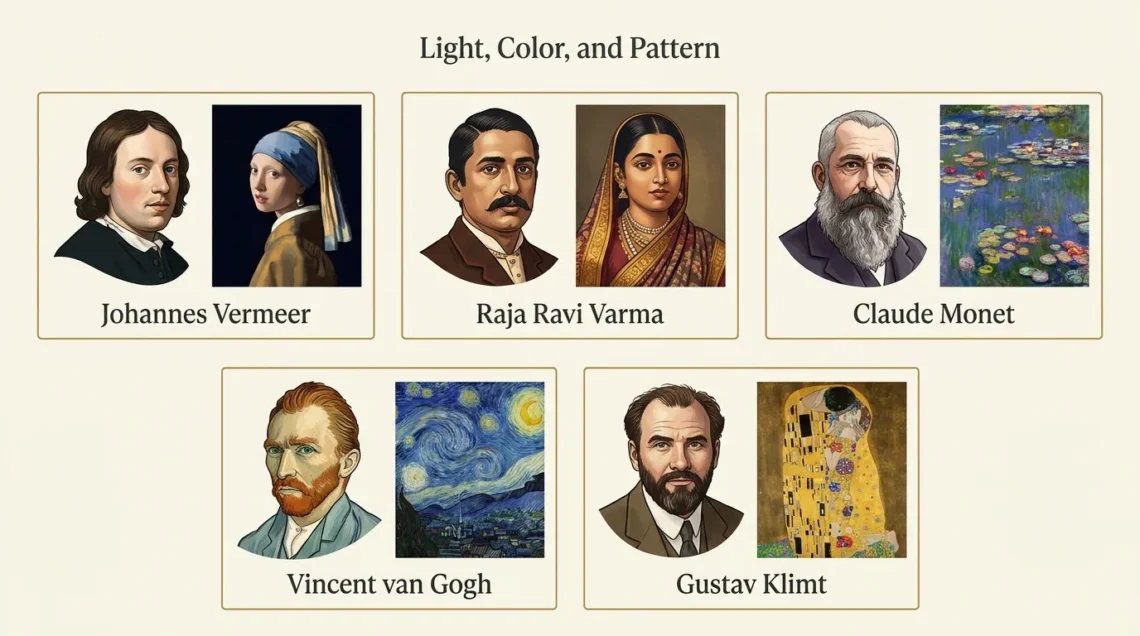
Vermeer’s image feels direct: a figure turns toward you against a dark background. Small highlights help describe the eyes, lips, and earring.
There is an important distinction here. The Mauritshuis calls the work a tronie, a study of a character or type, rather than a portrait made to record a particular person’s likeness.
You do not need to solve the girl’s identity to examine the painting. Start with the light and the turn of the head.
New Approaches to Light, Color, and Pattern
These painters did not belong to one movement. Placing their works together helps reveal different choices: making figures look solid, studying reflections, showing expressive marks, or filling a picture with decoration.
7. Raja Ravi Varma — Portrait of a Lady
Indian painter Raja Ravi Varma worked with European approaches to realistic painting while depicting Indian subjects. His work includes portraits and scenes drawn from Hindu stories.
Portrait of a Lady, held by the National Gallery of Modern Art in New Delhi, offers a starting point for his portrait work. Look at how shading helps suggest the form of the sitter.
His importance also extends beyond individual canvases. He established a press that produced affordable color prints, helping his images reach people who could not own an original painting.
8. Claude Monet — Water Lilies
French painter Claude Monet returned repeatedly to the lily ponds in his garden at Giverny. Water Lilies refers to a series, so the title does not identify just one canvas.
MoMA’s three-panel example spreads water, plants, and reflections across a wide surface. There is no clear horizon separating land from sky.
Try following one area of reflected color instead of searching for a single central object. The painting encourages you to notice how water changes what you see. View MoMA’s example.
9. Vincent van Gogh — The Starry Night
Van Gogh was Dutch, though he made The Starry Night in Saint-Rémy, France, in 1889. Curving marks and strong contrasts give its sky a sense of movement.
The work combines observation with changes made through imagination. MoMA describes it as both connected to the view from his window and a departure from that view.
Compare the active sky with the village below. You can describe that contrast before deciding what feeling it creates for you. The marks themselves become part of the subject.
10. Gustav Klimt — The Kiss
Austrian painter Gustav Klimt brings figures and decoration together in The Kiss. The couple’s clothing is covered with patterns that draw attention alongside their embrace.
The shimmering surface is not only an illusion created with yellow paint. The Belvedere records gold, silver, and platinum leaf among the materials used.
Notice how the faces remain distinct while much of the clothing merges into the surrounding decoration. Compare the recognizable human features with the repeating shapes.
Modern Painters of People and Everyday Life
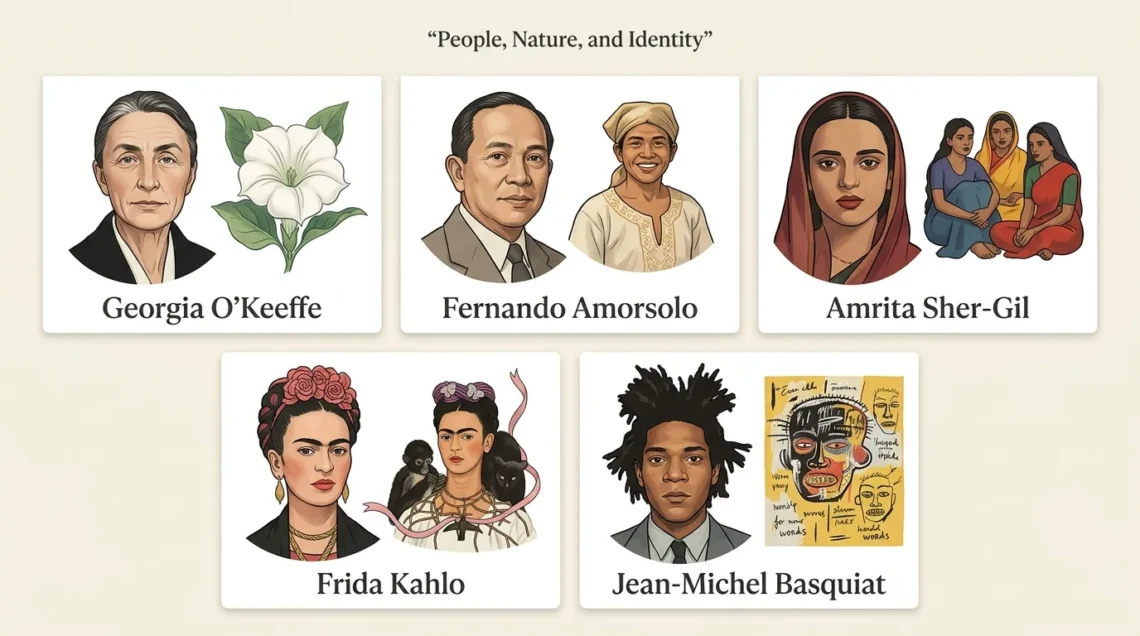
A flower, a country figure, or a self-portrait can hold more than a simple record of appearance. These artists use familiar subjects to explore attention, identity, and the world around them.
11. Georgia O’Keeffe — Jimson Weed/White Flower No. 1
American painter Georgia O’Keeffe makes a single flower feel large enough to enter. In this 1932 work, pale petals fill much of the picture, with green leaves around them.
Crystal Bridges describes her close cropping and enlarged subject as a way to bring attention to nature’s details.
Look at the curves of the petals before trying to attach a hidden meaning to them. The change of scale gives a small, familiar subject the attention you might usually give a much larger scene.
12. Fernando Amorsolo — Dalagang Bukid
Filipino painter Fernando Amorsolo is known for countryside scenes and figures. Dalagang Bukid, or The Country Lass, provides a specific example from 1928.
The National Museum of the Philippines describes the smiling figure’s traditional clothing and head covering. Begin with those details rather than treating the image as a general picture of all Filipino women.
The work presents an artist’s chosen ideal of rural beauty. That distinction matters: a painting can reveal how its maker wished to represent a person or place without being a complete record of everyday life. National Museum
13. Amrita Sher-Gil — Group of Three Girls
Amrita Sher-Gil is an important figure in modern Indian painting. Group of Three Girls dates from 1935, after her return from studying in Paris.
The figures have simplified forms and strong areas of color. Their poses offer a different kind of human presence from Caravaggio’s sudden action.
Notice the spaces between the figures and how the colors hold them together. Their expressions may suggest different feelings to different viewers. Describe what you can see before assigning each person a story the painting does not confirm.
14. Frida Kahlo — Fulang-Chang and I
Mexican painter Frida Kahlo places herself beside her pet monkey in Fulang-Chang and I. A pink ribbon connects them, making their relationship a visible part of the image.
The painting dates from 1937; the accompanying mirror and framing were added later.
Kahlo is often discussed alongside Surrealism, art associated with dreams and unexpected combinations. Yet MoMA also records her insistence that she painted her own reality. This difference is useful to remember when considering how closely a label fits an artist’s work.
15. Jean-Michel Basquiat — Hollywood Africans
American painter Jean-Michel Basquiat combines faces, words, numbers, and crossed-out phrases in Hollywood Africans, made in 1983.
The Whitney explains that the painting addresses stereotypes of African Americans in entertainment. Its figures include Basquiat and two companions who traveled with him to Los Angeles.
Start by reading the words, including the ones crossed out. Then notice how they change your understanding of the faces. The writing belongs to the painting’s meaning; it is not simply a label added beside the image.
New Forms, Dream Worlds, and Abstract Painting
Some painters change recognizable forms; others build pictures from marks and color. Abstract painting gives those elements a main role without needing to show an easily recognized person, object, or place.
16. Pablo Picasso — Guernica
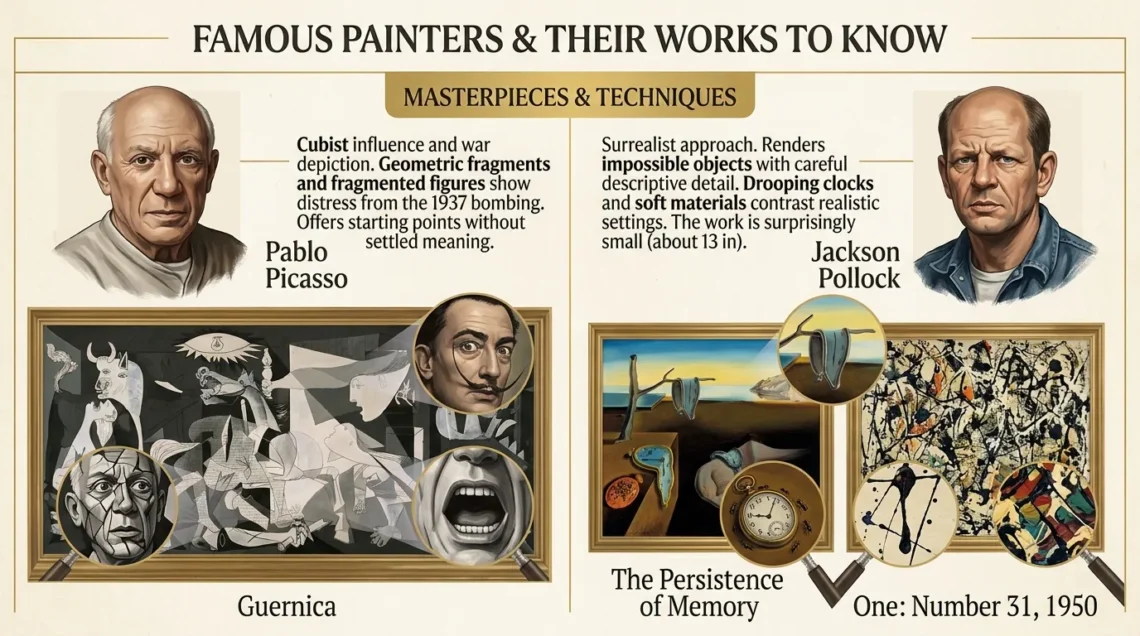
Spanish painter Pablo Picasso made Guernica in 1937. Its distressed people, animals, and broken forms confront suffering connected with war.
Picasso also helped develop Cubism with Georges Braque. This approach broke forms into geometric parts and challenged the idea of showing a subject from one fixed viewpoint.
Guernica belongs to a later moment in his career, so it should not stand in for everything Cubism means. Look first at the repeated open mouths and sharp shapes. They offer a starting point without settling every symbol’s meaning.
17. Jackson Pollock — One: Number 31, 1950
American painter Jackson Pollock made this work by pouring, dripping, and flicking paint onto canvas laid on the floor. Overlapping trails record those movements.
The approach is associated with Abstract Expressionism, a movement that gave a central role to expressive paint handling and abstract forms.
Instead of searching for a hidden face, follow one line until another crosses it. Then step back and compare dense areas with more open ones.
18. Salvador Dalí — The Persistence of Memory
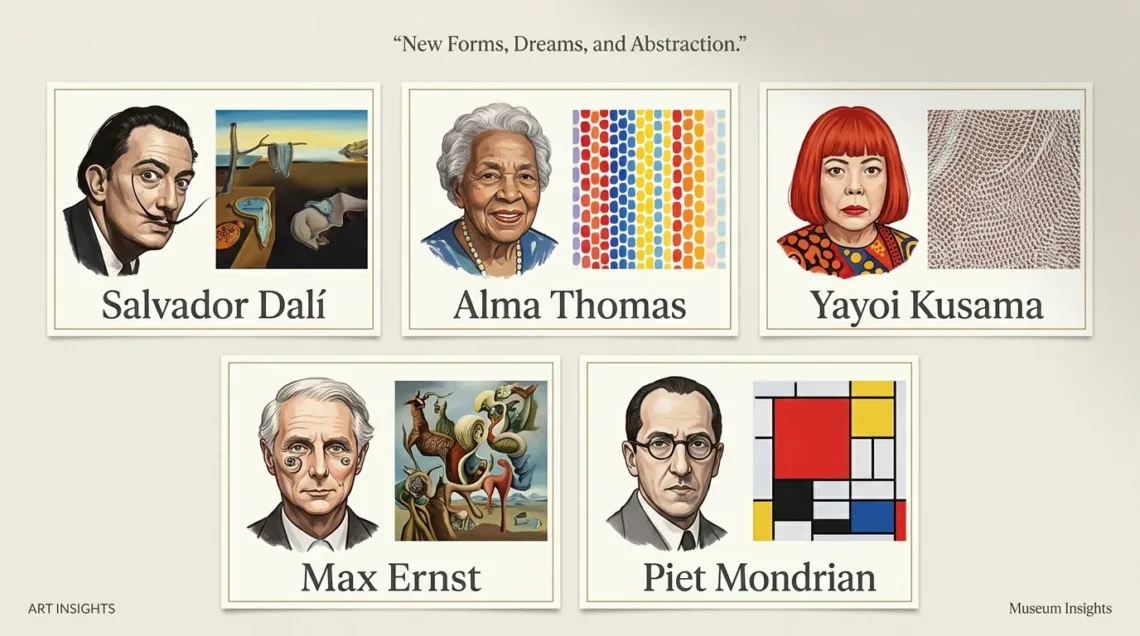
Spanish painter Salvador Dalí gives impossible objects a carefully described setting in The Persistence of Memory. Clocks droop as though their solid material has turned soft.
This contrast makes the work a useful introduction to Surrealism. You recognize the objects, yet they do not behave as expected.
The painting is also surprisingly small: MoMA records a width of about 13 inches. Knowing its size adds another point of interest to the tiny details and strange space inside it.
19. Alma Thomas — Light Blue Nursery
Alma Thomas, a Black American painter, built abstract works from bright colors and repeated marks. Light Blue Nursery arranges small, uneven blocks across a pale surface.
The Smithsonian connects the painting’s ordered energy with a garden. Its description also stresses that the shapes and colors were carefully considered.
Follow a row and look for changes in the marks. Repetition does not mean every shape is identical. Compared with Pollock’s crossing trails, Thomas offers a different rhythm: separated touches whose colors and spacing help carry your eye across the picture. Look closely at Light Blue Nursery.
20. Yayoi Kusama — No. F
Japanese artist Yayoi Kusama works across several media, including painting. No. F, made in 1959, belongs to her Infinity Nets series.
Small repeated loops build a web across the surface. Thickly applied paint, called impasto, gives the marks a physical texture.
Try comparing the tiny units with the larger field they create. From close up, individual marks matter; from farther away, the repeated pattern becomes the main experience. It shows how repetition can shape a whole painting.
How to Look at a Painting Without Knowing Art Terms
Choose one work rather than trying to remember all 20 names at once. A museum’s collection page gives you an image and reliable basic information. Begin with the image before reading a long explanation.
- Identify what is visible. Name a person, flower, building, shape, or repeated mark. If there is no recognizable subject, describe the colors and lines.
- Notice the treatment. Are edges soft or sharp? Does the paint look smooth or thick? Is light spread evenly or concentrated in one place?
- Follow your attention. What catches your eye first? Look for a bright patch, a face, a strong contrast, or a line that leads elsewhere.
- Read and compare. Check the title, artist, medium, and museum explanation. Separate what you observed from what the source tells you about its context.
For example, you might notice repeated colored marks in an Alma Thomas painting before learning about its connection to nature. Your observation gives the explanation something concrete to attach to.
A useful result is being able to name two visible details and explain one choice. You do not need to discover a secret message or agree with every interpretation to have looked carefully.
Frequently Asked Questions
Who is the most famous painter?
Leonardo da Vinci is a strong starting answer because of the recognition attached to the Mona Lisa. However, “most famous” needs a measure, such as public recognition in a particular country. A familiar painting does not establish one worldwide winner across every audience.
Who are the “big 7” painters?
Check which source is using that phrase. A seven-person selection may describe a particular period, country, or writer’s choices. Without that context, assigning seven names would suggest an agreed group that the phrase alone does not establish.
Is every famous artist a painter?
No. “Artist” is the broader term. Artists may work in sculpture, photography, printmaking, performance, or other media. Some also paint. Michelangelo and Kusama show why a person can belong to more than one category; check the medium of the individual work.
Do you need to know art history to enjoy a painting?
No. You can begin with color, expression, texture, or a subject that interests you. Historical context can then explain details you might miss, such as a saint’s identifying object or a reference to social conditions. Enjoyment and learning can develop together.
Choose One Painting to Explore
Pick the work that made you curious and open its museum record. Look before reading, then return to the image after learning one new fact. Notice what changes in your attention: that small comparison is a useful next step toward understanding the painter.
Disclaimer:
This guide draws on museum and institutional records reviewed in October 2026. The selection is not a universal ranking, and interpretations of individual paintings can differ.